Science
DynaClim connects orbital and rotational dynamics with planetary climate modelling, particularly for planets around low-mass stars.
Tidal interactions of close-in planets
Tides govern the orbital and spin evolution of planets that orbit very close to their star or brown dwarf. My early work established how tidal dissipation shapes semi-major axes, eccentricities, obliquities and rotation periods across a wide variety of host bodies — from brown dwarfs to Sun-like stars — and how the evolving spin of the host star feeds back on those orbits. With Stéphane Mathis, I later showed that the amplitude of stellar tidal dissipation can vary by orders of magnitude with stellar mass, age and rotation, making the orbital history of close-in planets strongly dependent on the detailed evolution of their host.
Key papers: Bolmont, Raymond & Leconte (2011, A&A) — tidal evolution around brown dwarfs · Bolmont, Raymond, Leconte & Matt (2012, A&A) — effect of stellar spin history · Bolmont & Mathis (2016, CeMDA) — rotation and tidal dissipation history
Numerical tools: Posidonius and friends
A recurring theme in my research is the development of open, publicly available numerical tools. I first developed Mercury-T, an extension of the Mercury N-body code with tidal evolution and evolving stellar/brown-dwarf radii. Its successor, Posidonius — co-developed with Sergi Blanco-Cuaresma and described on the project page — rewrites and extends Mercury-T in the Rust programming language, improving spin integration, memory safety and reproducibility, and adding support for tidal inertial wave dissipation in stellar convective envelopes. More recently, the DynaClim group has developed SPIROID for star–planet interior–tidal coupling, and contributes to the Generic-PCM three-dimensional global climate model. Team member Alexandre Revol has used Posidonius to study the precise spin states of the TRAPPIST-1 planets, showing that they oscillate around — rather than sit exactly at — synchronous rotation, with direct consequences for heat redistribution and JWST observations.
Key papers: Bolmont et al. (2015, A&A) — Mercury-T · Blanco-Cuaresma & Bolmont (2017) — Posidonius · Revol, Bolmont et al. (2024, A&A Letters) — substellar point drifts in TRAPPIST-1
Habitability of planets around low-mass stars
The habitable zone of an ultracool dwarf or brown dwarf sweeps inward as the object cools, so any planet that eventually reaches temperate conditions has first endured a prolonged hot phase. I studied how much water such planets can retain despite intense XUV irradiation and this early runaway greenhouse, applying the results to the TRAPPIST-1 system immediately after its discovery. This body of work provides observational priors on atmospheric survival and water budgets for the most promising rocky-planet targets known.
Key papers: Bolmont et al. (2011, A&A) — habitable zone around brown dwarfs · Bolmont, Selsis, Owen et al. (2016, MNRAS) — water loss around ultracool dwarfs and TRAPPIST-1
TRAPPIST-1 system
The seven-planet TRAPPIST-1 system sits at the centre of much of my recent research. I have contributed to constraining its tidal, atmospheric and interior evolution: modelling tidal heating as a function of internal structure, quantifying the impact of tidal dynamics on transit-timing fits, and co-authoring climate studies with 3-D general circulation models that map possible surface conditions on each planet. The arrival of JWST observations makes this work more urgent — and more testable — than ever. A recent study led by team members Emeline Bolmont and Alexandre Revol revisited all seven planets' tidal heat budgets, finding that TRAPPIST-1 b and c could approach Io-level heat fluxes potentially detectable with JWST.
Key papers: Turbet, Bolmont et al. (2018, A&A) — climate diversity and volatile fate · Bolmont et al. (2020, A&A) — tidal heating in the outer planets · Turbet, Bolmont et al. (2020, SSRv) — review of possible atmospheres · Revol, Bolmont et al. (2024, A&A Letters) — substellar point drifts · Bolmont, Sastre, Revol et al. (2026, A&A) — tidal heating and internal structure
Climates and the runaway greenhouse
Understanding when and how a planet transitions from habitable to uninhabitable requires modelling the full runaway greenhouse process. I collaborate on 3-D global climate simulations that track volatile cycles, CO₂ condensation, atmospheric escape and the coupling between tidal spin-state and climate. A landmark study led by former PhD student Guillaume Chaverot achieved a world first: a complete, end-to-end simulation of the runaway greenhouse transition with a 3-D GCM, revealing a rapid and hard-to-reverse shift in cloud coverage that had not been seen in 1-D models. A companion Nature paper showed that steam atmospheres commonly develop radiative layers that prevent surface magma ocean formation — revising constraints on the water contents of rocky planets around red stars.
Key papers: Turbet, Bolmont et al. (2018, A&A) — climates of TRAPPIST-1 · Chaverot, Turbet, Bolmont & Leconte (2022, A&A) — background atmosphere and runaway onset · Chaverot, Bolmont & Turbet (2023, A&A) — first 3-D GCM exploration of the runaway greenhouse · Selsis, Leconte, Turbet, Chaverot & Bolmont (2023, Nature) — cool runaway greenhouse without magma ocean
Formation and characterisation of planetary systems
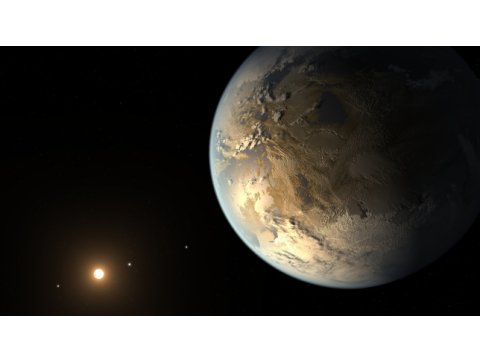
Combining tidal modelling with planet-formation theory, I have studied specific systems to constrain their histories and habitability. A study of Kepler-186 — home to the first Earth-sized planet discovered in a habitable zone — modelled the system's formation, tidal circularisation and spin synchronisation, and used a 1-D climate model to assess the surface conditions of Kepler-186f. Similar multi-faceted analyses have been carried out for Kepler-62 and other compact systems.
Key papers: Bolmont, Raymond, von Paris et al. (2014, ApJ) — Kepler-186 formation and habitability · Bolmont et al. (2015, A&A) — Kepler-62 with Mercury-T